
Charlotte-area barndominiums
Barndominium Builders in Charlotte, NC
Steel and post-frame homes planned around red clay, humid summers and county permits.
- Free site visit before any price
- Written, line-item estimates
- County permit and septic research included
Barndominiums on Piedmont Land
Barndominium Builders Charlotte builds barndominium homes, shop houses and custom barndos for landowners across the Charlotte region of North Carolina. As barndominium builders working on the NC side of the metro, from Mecklenburg out to Iredell, Rowan, Stanly, Union, Gaston, Lincoln and Cleveland counties, we plan each home around the land it sits on, the county that permits it and the climate it has to handle.
North Carolina treats a barndo as a house
There is no separate rulebook for barndominiums here. A barndo used as a home is a single-family dwelling under the North Carolina State Building Code, which is based on the International Residential Code with state amendments. The 2024 North Carolina Residential Code took effect on July 1, 2025. That means the same inspections as any site-built home: footings, rough-ins and a final inspection before a certificate of occupancy. In Mecklenburg County, residential new construction requires plan review before a permit is issued.
Red clay, and clay that moves
Charlotte sits in the Carolina Piedmont at roughly 750 feet. Much of the region's upland soil has a sandy loam surface over red clay, like the Cecil series, which the USDA describes as well drained. Not every tract is that forgiving. The Iredell series, also mapped on Piedmont uplands in North Carolina, is very slowly permeable with very high shrink-swell potential in its subsoil and a perched water table 1 to 2 feet down from December through April. On ground like that, slab design, grading and drainage matter as much as the building itself.
Humid summers, freezing nights, real storms
Charlotte has a humid subtropical climate. Normal July highs run about 90 degrees, about 43.6 inches of rain falls in a year, and the city still sees roughly 59 nights a year at or below freezing. Ice is a bigger winter threat than snow: the December 2002 ice storm left more than 1.3 million people without power. Hurricane Hugo reached Charlotte in 1989 with gusts of 87 mph and destroyed about 80,000 trees. A metal building in this climate needs a deliberate plan for condensation, insulation and how the frame is tied down against wind.
Rural lots mean septic and wells
Much of the land people buy for a barndo is outside sewer and water service. In North Carolina, the local health department evaluates the soil and issues an improvement permit and an authorization to construct before a septic system goes in; a well permit is a separate step. We build that research into the plan early, because a lot that cannot pass a soil evaluation changes everything else.
What we build
Barndominium homes with open living space under a clear-span roof, fully custom barndo designs, kit-based builds, floor plans drawn for your lot, shop houses with living quarters attached, and turnkey projects from site prep to move-in. Steel frame and post-frame (wood) construction are both on the table; we will explain the trade-offs for your site and plan.
Where We Build Barndominiums
We build across nine North Carolina counties around Charlotte, and they are not all the same ground.
Mecklenburg County is mostly city and suburbs, so a barndo here usually means a larger lot on the edges of the county or near the Catawba River, Mountain Island Lake or Lake Wylie. Mecklenburg County Code Enforcement handles building permits, and the county's Groundwater and Wastewater Services office handles septic and private well permits.
Lake Norman country (Iredell and Lincoln). Lake Norman, created behind Duke Energy's Cowans Ford Dam, is the largest human-made lake in North Carolina, with about 520 miles of shoreline touching Iredell, Lincoln, Mecklenburg and Catawba counties. Southern Iredell is growing fast; the northern third around and above Statesville is highly rural, rising to the Brushy Mountains and 1,760-foot Fox Mountain. About three quarters of Lincoln County residents live in rural areas.
East of Charlotte (Cabarrus, Rowan, Stanly, Union). Cabarrus is gently rolling Piedmont between about 500 and 800 feet, sloping southeast, with the westernmost Uwharrie foothills in its eastern half. Stanly County sits in the Uwharrie Mountains, the worn-down remains of a volcanic arc in the Carolina Slate Belt; slate-belt soils such as the Badin series can hit weathered rock within 20 to 40 inches, which matters for footings and septic fields. The Yadkin River forms Rowan's eastern border. Union County, with Monroe as its seat, covers nearly 640 square miles of farm and suburban land.
West of the Catawba (Gaston and Cleveland). Gaston is rolling terrain broken by ridges, with Kings Pinnacle at Crowders Mountain rising to 1,690 feet. Cleveland County, around Shelby, sits in the foothills of the Blue Ridge and is very hilly in places, with the South Mountains in its northwest corner. Sloped lots here often need more grading, retaining or a stepped foundation.
Energy code climate zones also split the region: Mecklenburg, Cabarrus, Union, Gaston, Rowan and Stanly are in zone 3A, while Iredell, Lincoln and Cleveland are in zone 4A, which affects insulation targets.
- Barndominium Builders in Charlotte, NC
- Barndominium Builders in Concord, NC
- Barndominium Builders in Harrisburg, NC
- Barndominium Builders in Kannapolis, NC
- Barndominium Builders in Mooresville, NC
- Barndominium Builders in Statesville, NC
- Barndominium Builders in Huntersville, NC
- Barndominium Builders in Mint Hill, NC
- Barndominium Builders in Matthews, NC
- Barndominium Builders in Indian Trail, NC
- Barndominium Builders in Monroe, NC
- Barndominium Builders in Waxhaw, NC
- Barndominium Builders in Marshville, NC
- Barndominium Builders in Locust, NC
- Barndominium Builders in Albemarle, NC
- Barndominium Builders in Salisbury, NC
- Barndominium Builders in China Grove, NC
- Barndominium Builders in Gastonia, NC
- Barndominium Builders in Belmont, NC
- Barndominium Builders in Mount Holly, NC
- Barndominium Builders in Cherryville, NC
- Barndominium Builders in Lincolnton, NC
- Barndominium Builders in Shelby, NC
- Barndominium Builders in Midland, NC
- Barndominium Builders in Stanfield, NC
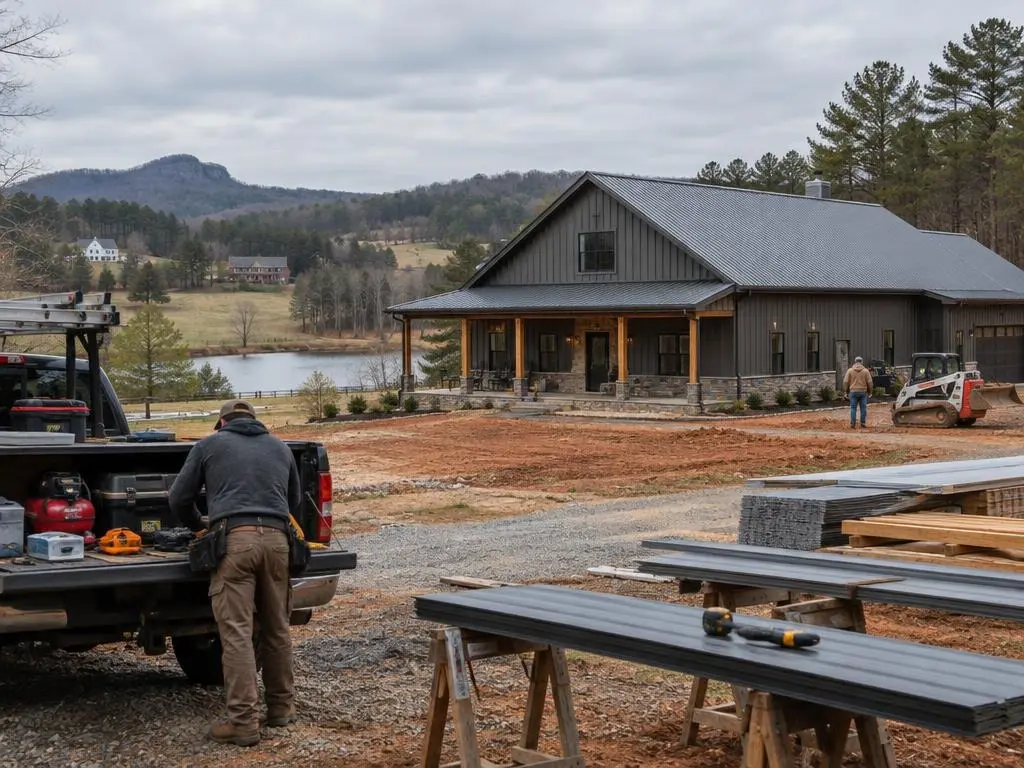
Why Homeowners Call Barndominium Builders Charlotte
We see the land first
Every estimate starts with a visit to your property to look at slope, drainage, access, trees and where the house, shop, septic field and well can go.
County research up front
We check zoning, the permit path, health department septic rules and any HOA or deed restrictions for your parcel before design gets expensive.
Line-item written pricing
Site work, slab, building package, insulation, mechanicals and finish-out are priced separately so you can see where the money goes.
A condensation plan for metal
Humid Piedmont summers and freezing winter nights are hard on metal shells. We spell out the insulation, vapor control and HVAC approach in writing.
Common Questions
Are barndominiums legal in North Carolina?
Yes. North Carolina treats a barndominium used as a home like any other site-built single-family dwelling. It has to meet the state residential code and pass the same inspections. Local zoning and private HOA or deed covenants can still restrict metal-sided homes on some parcels, so we check those for your lot first.
How much does it cost to build a barndominium near Charlotte?
It depends on size, finishes and how much site work your land needs. Our service pages list typical Charlotte-area and North Carolina cost ranges from named cost guides. Septic, wells, clearing and driveways add to the total on rural land, and your written estimate is the price.
Do I need a permit to build a barndominium in Mecklenburg County?
Yes. Mecklenburg County Code Enforcement issues building permits, and residential new construction requires plan review. If the lot is not on public sewer or water, septic and well permits go through the county's Groundwater and Wastewater Services office.
Can I get a mortgage for a barndominium?
Often, yes, but it takes more preparation. Most new barndos are financed with a construction-to-permanent loan, and lenders commonly expect detailed plans and around 20% down. The usual hurdle is the appraisal, because there may be few comparable barndos nearby. We do not provide financing, but we supply the plans and line-item costs lenders ask for.
How long does it take to build a barndominium?
HomeGuide puts a typical barndominium at around six months, longer for larger or more customized homes. On rural land, septic evaluation, permitting and site work can add time before construction starts.
Steel frame or post-frame: which is better here?
Both work. Steel frames allow wide clear spans and resist rot and insects; post-frame (pole building) construction uses wood posts and is familiar to many framers and inspectors. Wind design, insulation method and your floor plan usually decide it. We price both when it makes sense.
How do you stop condensation in a metal barndominium?
Condensation forms when warm, humid inside air reaches cold metal. Closed-cell spray foam applied to the shell acts as an air and vapor barrier and, in building-science modeling, needs no added vapor retarder; open-cell foam in a metal wall can take on moisture. Code also requires a thermal barrier such as drywall over spray foam.
Do you build on land outside Charlotte city limits?
Yes. We build on acreage and larger lots in the counties around Charlotte, including Cabarrus, Union, Iredell, Lincoln, Gaston, Rowan, Stanly and Cleveland.
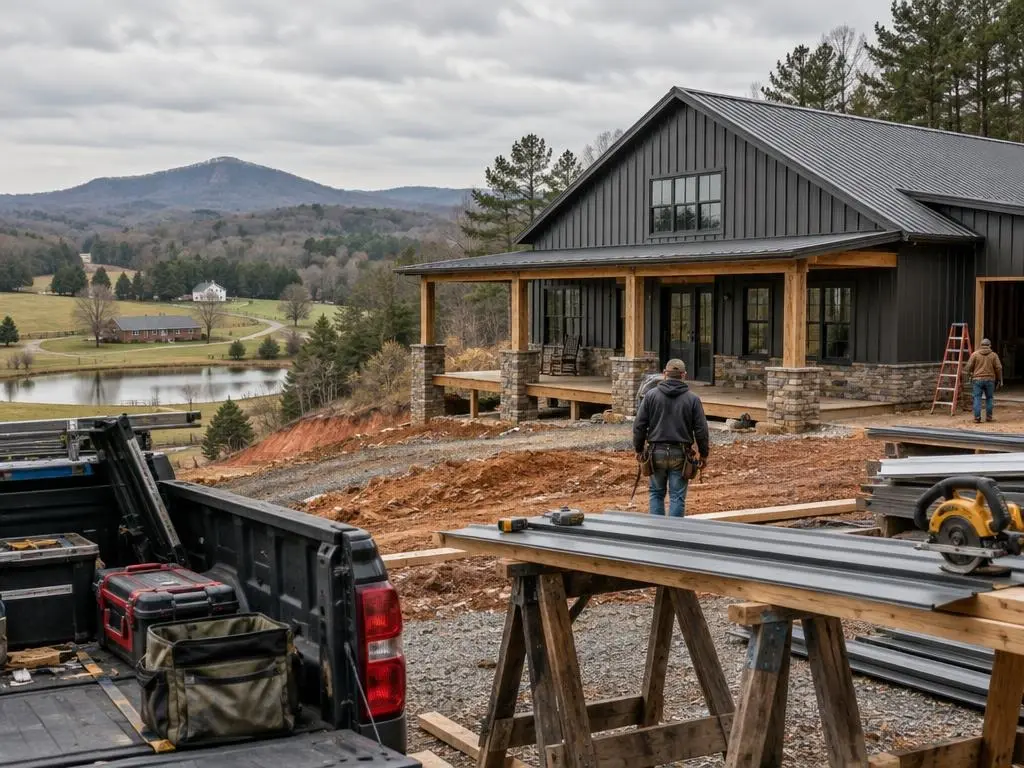
Barndominium Services
Six ways to build a barndominium around Charlotte, from a kit shell to a move-in-ready home.
Barndominium Homes
Full-time barndominium homes with open living space, built to North Carolina's residential code.
Learn more →Custom Barndominium Builds
A barndo designed from scratch around your land, your floor plan and how you live.
Learn more →Barndominium Floor Plans
Floor plans drawn or adapted for your lot, your family and North Carolina code.
Learn more →Turnkey Barndominiums
One builder from raw land to keys: site work, septic, shell and finish-out.
Learn more →Planning a Barndominium Near Charlotte?
Call (980) 689-3758 or send the details of your land for a free site visit and written estimate.